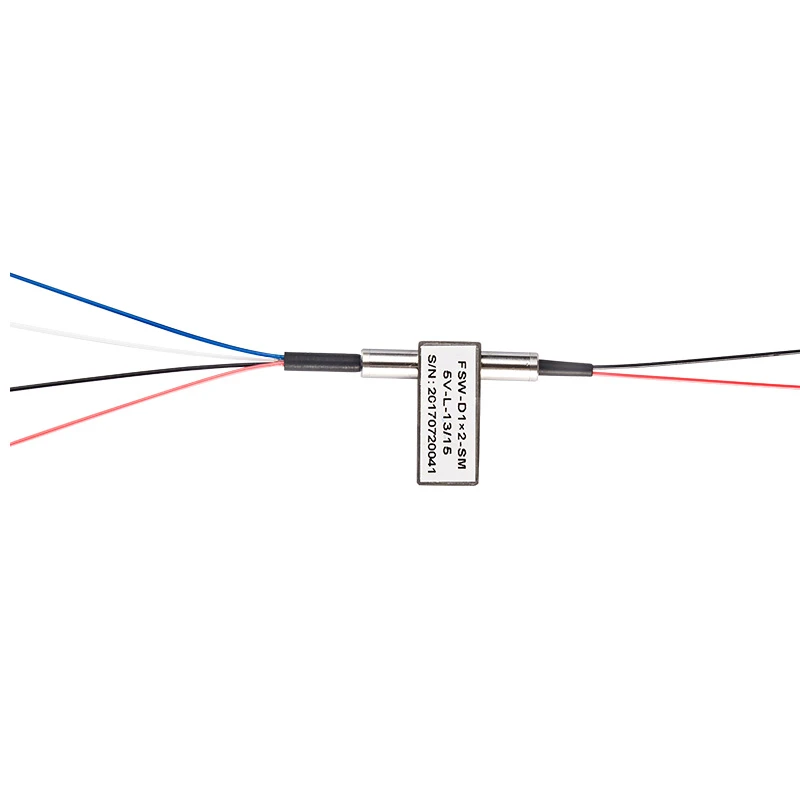
Optic circulator, Optic Isolator, Optic Switch ,Optic attenuator
Optic circulators, isolators, switches, and attenuators are essential components in fiber-optic communication systems. These devices are commonly used in telecommunications, data centers, and research laboratories for managing light signals and ensuring efficient data transmission. Typical buyers include network engineers, telecommunications companies, and research institutions.
Buyers should confirm the specifications for optic devices, including types (e.g., circulators, isolators), wavelength ranges, and insertion loss parameters. It is also advisable to inquire about connector types, compatibility with existing systems, and any certifications required. Additionally, check for minimum order quantities (MOQ) and lead times for delivery.
Fiber-optic devices can be classified by function into categories such as optical connectors, optical couplers, optical switches, wavelength division multiplexers/demultiplexers, optical attenuators, optical circulators, optical isolators, and optical modulators. **Optical Connectors:** Devices that establish optical connections between optical fibers or between a fiber and another component. Their primary parameter is insertion loss. There is a wide variety of optical connectors; they can be classified by plug structure (e.g., O-type, C-type, V-type), by fiber type and core count (e.g., multimode vs. single-mode, multi-core vs. single-core), and by application (e.g., general-purpose, field-terminable, sealed, and wall-feedthrough types). The insertion loss for a standard multimode single-core fiber connector is typically 0.5–1 dB, while the lowest insertion loss for a single-mode fiber connector can reach 0.3 dB. **Optical Directional Couplers:** Devices that enable proportional energy coupling between optical paths; the splitting of the optical path depends on the direction of transmission, allowing for the creation of three-port or four-port devices. Depending on structure and fabrication technology, they can be classified as offset-joint, fused-taper, angled-mirror, or planar types (Figure 3). Key parameters include insertion loss, splitting ratio, and isolation. They are primarily used for single-fiber bidirectional transmission and data networks. **Optical Star Couplers:** Devices that couple optical energy from one or more input paths to one or more output paths on the same side (or the opposite side), forming a star-like configuration. Couplers that direct energy to paths on the same side are called reflective star couplers, while those directing energy to the opposite side are called non-reflective star couplers. They can also be classified by port configuration, such as 1×n or n×n types. Based on structure and fabrication, they can be categorized as fused-taper or rod-lens types (Figure 4). Their key parameters are the same as those of directional couplers; they are primarily used in star-topology fiber networks. **T-Couplers:** Devices that connect two terminal units to a main transmission line. Their basic structure and parameters are similar to those of star couplers, and they are primarily used in bus-topology networks. An optical switch is a device that connects, disconnects, or redirects optical signals from one or more optical paths to others. Based on switching configuration, they are classified as 1×n or n×n (matrix) types; based on the switching mechanism, they are categorized as mechanical or solid-state types (Figure 5). Key parameters include insertion loss, isolation, repeatability, switching time, and operational lifespan. They are primarily used for optical path switching. A wavelength division multiplexer (WDM) is a device that enables two or more optical signals at different wavelengths to share a single optical path. Based on wavelength tunability, they are classified as fixed, tunable, or continuously tunable types (Figure 6). Key parameters include the multiplexing ratio and precision. They are primarily used for optical signal transmission in relay sections. Beyond their application in fiber-optic communications, fiber-optic devices are also utilized in non-communication fields such as sensing technology, data processing, and computing. Fiber-optic sensors, in particular, have garnered significant attention, and their advancement drives the overall development of fiber-optic devices. Miniature fiber-optic sensors—characterized by compact size, high sensitivity, and responsiveness to external stimuli—enable high-sensitivity detection and find applications in biomedical fields like photoacoustic imaging. Furthermore, to meet the demands of single-mode fiber transmission systems, fiber-optic devices are evolving from discrete planar components toward hybrid integration, a shift that will significantly impact fiber transmission systems.
Est. price range
₹50 (≈ US$0.53 indicative, 25 Oct)
⚡ Sourcing insights
Commercial suitability
You need reliable fiber-optic components for communication systems.
Essential devices for efficient optical signal management.
"Comprehensive range of fiber-optic devices for various applications."
Pro tip: Consider the insertion loss and application type when selecting optical components.
Detailed specifications will be shared by the supplier in their official quote.
Include your exact spec requirements in the RFQ note.
Compare more Electronic Components suppliers, or see Electronic Components suppliers in Shenzhen.
Supplier
On BroostShenzhen Pusmai Technology Co.,Ltd
Supplier
🇨🇳 Shenzhen, Guangdong, China
Your contact stays private until you choose a supplier.
Free · No commission
Mutual consent
No spam guaranteed
Zero commission
Price straight from the supplier
Similar products
WIN SOURCE – Worldwide Electronic Component Distributor
Price on request
OnlineComponents.com – Authorized Electronic Component Distributor
Price on request
Custom DIY PCB Board Manufacturing Service
US$0.20
Wholesale Bus Interface Products
Price on request
ADH3853 High-Speed DC Fuse
Price on request
Authorized Electronic Components Distribution
Price on request
Ready to source Optic circulator, Optic Isolator, Optic Switch ,Optic attenuator?
Get an official quote directly from Shenzhen Pusmai Technology Co.,Ltd with zero commission.
Free · Zero commission
Sourcing for United States
Showing suppliers who can serve your location. Prices in USD.